


When you grow up, you learn that thinking of history as a constant, upward trajectory of progress towards the future is rather naive.
Our understanding and development of technology may grow because it builds upon knowledge gained by previous generations, but there’s no guarantee that it’ll lead us to a pot of gold at the end of the rainbow.
As we speak, the AI revolution is reminding us of that lost lesson from the fin-de-siècle: that advancements in technology can make us go backwards in other areas.
We can observe a similar effect—albeit much less of an existential threat—in video game development.
With developers having more tools than ever to create grand, crisp-looking games with infinitely big worlds, we are starting to see that unlimited possibilities don’t always lead to great outcomes.
Optimization increasingly seems to be a thing of the past, with many a big production coming out as a bloated, stuttery mess—their technological complexity having produced a thick layer of ray-traced Unreal Engine 5 jank that does its best to hide the great game that may or may not be hiding underneath.
Conclusion: better technology doesn’t always make for a better experience.
This principle can also be applied to the gameplay side of things, where a bigger array of possibilities may cause the disappearance of mechanics now deemed archaic. Yet, upon closer inspection, it may sometimes turn out that the thing we got in their stead is not an actual substitute for what we lost.
This is why, today, I would like to plea for the return of an increasingly rare species in multiplayer-oriented games:
The bot.
Given that games have mostly evolved away from bots, I feel obligated to explain what I even mean with the term: computer-driven characters (opponents or allies) that serve as a stand-in for real players in the multiplayer mode of a game.
Admittedly, the line between a bot and a regular NPC is a bit vague—we can consider non-human opponents in a game like Mario Kart bots, and those are still commonplace in that genre.
Still, when the concept of multiplayer became popular on home consoles in particular, developers were for a time almost almost forced to put an option for bots in multiplayer-oriented modes and games to make them viable for prolonged enjoyment.
In the mid-to-late nineties, we had not yet reached the point where having a high-end internet connection was standard for the average household. Likewise, consoles did not yet ship with full online functionality—the 1998 Sega Dreamcast is considered the first to have such capabilities, and in hindsight, even at that stage the market might not have been ready for it.
So if you wanted to play multiplayer on a console in the ‘90s, it’d generally have to be local. When people reminisce about the heyday of Goldeneye multiplayer, they’re talking about four people on a couch all sharing the same minuscule television screen.
Then what did you do if your friends weren’t available, your friends were sick of losing to you, or you didn’t have any friends that were interested in video games?
In the case of Goldeneye’s multiplayer, you did nothing and you went back to the excellent single player campaign.
But for many other games in the late ‘90s to mid 2000s, it became common to offer you the option to play against bots.

Of course, bots are no replacement for a human player. They typically don’t have the same skills, they don’t react to psychological pressure, and there’s no sense of urgency there because beating Bot_04 just isn’t the same as beating your brother so hard that he starts putting you in a chokehold.1
And yet, there’s something distinctively beautiful about playing against bots. Rather than replacing gaming sessions with your friends, it becomes its own, unique experience.
Take Perfect Dark, Rare’s spiritual successor to Goldeneye. In the game, released in the dying days of the Nintendo 64 in 2000, there were about two dozen different types of bots—called sims in the game; no relation—all fully customizable in looks and skill, and coming with their own, idiosyncratic behaviors.
FeudSim would choose one opponent to focus for the entire match, whereas JudgeSim would single out whoever was in the lead during a match to take them down. CowardSim just tried to run away from the player, and the supremely annoying FistSim had a knack for just punching you in the face, which in Perfect Dark would disarm you and put a temporary dizzying effect on your screen.
Due to their unique, tinker-friendly nature, the use of these bots wasn’t restricted to glorified ‘replacement friends’ for lonely teens. Rather, they became a core part of the overall multiplayer experience.
When I played Perfect Dark with friends, we’d play almost no match without bots. It was way too entertaining to come up with fiendish bot set-ups for us to fight against.
We must’ve spent hours on the bots’ custom looks alone, with our pièce de résistance being a highly effective JudgeSim that looked like Shigeru Miyamoto dressed in a catsuit fit for a Bond Girl.
Of course, we could just as well have played against each other with no bots involved. On paper, playing against human opponents is much more fun. Especially when those opponents happen to be sitting right next to you.
And still, the botless Goldeneye got stale eventually. It’d only really be worth starting a match if there were four of us, and even then the whole experience started losing its charm once a clear hierarchy of skill emerged from our group.
By contrast, the only thing that got us to quit playing Perfect Dark was the advent of a new console generation. There were just so many optional challenges we could create for ourselves using the Combat Simulator—the game’s own name for its multiplayer mode—that it never truly got old.
That’s not to say you need to be able to tweak each bot to make it a worthwhile addition to a multiplayer game.
I remember playing Battlefield 1942 with friends, where instead of joining some big lobby full of human players, we’d try to hold back a literal army of bots with just the four of us.
One map was a small island with a few outposts facing the enemies’ initial spawn points in the sea. Each of us would man one of these outposts and individually hold back dozens of enemies in a rampage equal to that ridiculous final fight in Commando.
It was intense, competitive, stressful, and above all, heaps of fun as we’d desperately try to maintain control over our respective strongholds until we inevitably started collapsing one by one.
Again, it felt like its own game mode: a WW2-spinoff of Left 4 Dead that we just happened to come up with as we were thinking of fun new ways of playing the game.
Needless to say, our Pacific Thermopylae scenario could never have worked had all those bots been replaced by actual humans.
There are even multiplayer games that I’ve sunk hundreds of hours into without ever facing another player. The underappreciated Conker: Live & Reloaded for the original Xbox had a fantastic multiplayer mode that I played with bots simply because kid me couldn’t afford an Xbox Live subscription.
And despite having the option to go online on PC, I chose to play Star Wars: Battlefront I & II (the originals) with bots, because it turned the battles from simple deathmatch skirmishes into Dynasty Warriors-like grand strategy ordeals where I’d have to manage the battlefield from the perspective of a ground soldier, often being forced to embark on a desperate solo raid on a key strategic point in order to force a breakthrough.
As time went on, and online multiplayer became more integrated in gaming, developers felt like there was no real need to put bots in the game, and many players probably felt the same. What was the use for boring computer-controlled opponents when even people with no gaming friends could access random online lobbies full of human players?
Indeed, many modern first-person shooters, third-person shooters and other action games no longer offer the ability to play with bots, or restrict their use to a few isolated training scenarios. Far gone are the days when bots were actually core to multiplayer design, as we once witnessed in Perfect Dark.
While this may be understandable to a degree, a case for preserving bots is easily made. Many people dislike the stress that comes with the social aspect of gaming, and nowadays that can often mean having to lock yourself out of a major part of a game. And with more people becoming conscious of the importance of preserving video games, bots are a way—albeit an imperfect one—of ensuring that all content in a game remains playable even when the servers go down and no user-made alternatives are offered in their place.
A sound, socially conscious perspective for sure. But perhaps also painfully sensible and therefore boring.
My own perspective is more selfish. I miss the days of bots because they could give such a unique spin to the way I played the games that prominently featured them. They could turn a run-of-the-mill frag match into a horde shooter, or a capture-the-flag match into a real-time strategy campaign. Game modes that revolved around precise aiming and reaction time would tap into entirely different skillsets, such as crowd control, resource management and task prioritization.
The fading relevance of bots at the hands of faster internet connections led to the loss of an experience that—though it may seem obscure—was core to how I played video games growing up, and I reckon I’m not the only one.
Fortunately, bots haven’t fully died out. Just this week, I was pleasantly surprised to find out that the Star Fox remake for Switch 2 features a fully new multiplayer mode that comes with bot support. But for every such case, there is a long-standing series that ditched bots somewhere along the way, or even a remaster like Nightdive’s Turok 3 revival that just cut the entire bot-supported multiplayer mode from the game, presumably because “nobody plays that anyway.”
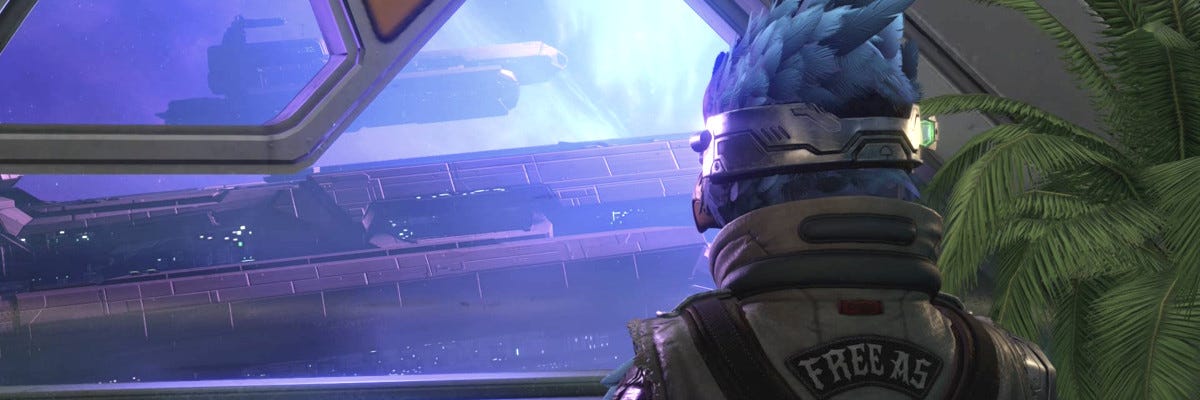
Therefore I would like to close this piece with a plea for the glorious return of the bot as a multiplayer staple.
Customizable, fun bots that feel like they were part of the developer’s vision rather than a barely fleshed out afterthought.
If you are a developer, this is a golden opportunity to be wildly original in 2026 by simply reviving a mechanic that may not quite be dead, but is definitely on life support.
So if you’re looking for a relatively simple way of adding a ton of depth and replay value to your game—bring back bots!
If nothing else, these days there are worse ways of replacing humans with computers…
Notes:
All screenshots taken and edited by me.
Yes, this has actually happened to me.
I never had Perfect Dark, so it was really fun to read this. You gotta love rare for going so hard on a system like that, it sounds like the exact thing I would have loved as a kid. Speaking of Goldeneye successors, I would often play The World Is Not Enough on N64 with my cousins and brother when we got bored of Goldeneye. The bots in that game had hyper-intelligent AI, and would find you as if they had X-ray vision (implementation-wise, they probably did). I remember how fun it was to try and outsmart it, and try to survive as it would make its way across the map, wiping me, my brother and my cousins out one by one. Felt like fighting vs. the Predator or something. I miss that sort of thing.
The introduction of bots to Perfect Dark massively changed my multiplayer matches compared to GoldenEye. The bots would never stand still, they weren't intelligent enough for that, so now the matches with 4 humans and 8 bots suddenly felt more frantic, like you constantly had to move around. It was so much fun, like you said, adjusting the personalities to them, setting them up on teams, praying the Dark Sim never found you. I really miss bots like you because I never really liked playing against other people online.