

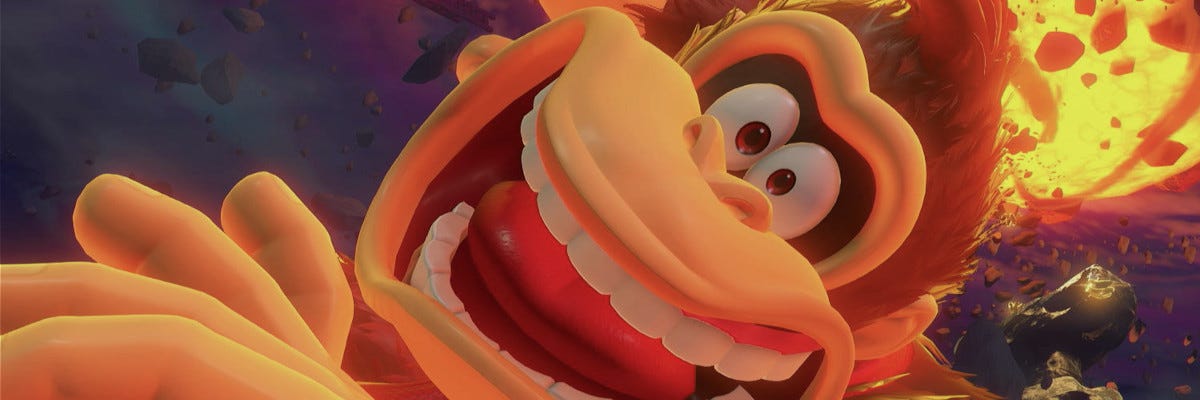
When Astro Bot won Game of the Year at The Game Awards in 2024, director/producer Nicolas Doucet went on stage and thanked—without specifically naming them—Nintendo. An odd choice when you consider that his Team Asobi studio is part of Sony, but one that is perfectly understandable when you know the history of the genre.
As a modern platformer, Astro Bot would ultimately not have existed without the efforts of Sony’s domestic rival. There is a strong case to be made that 1981’s Donkey Kong was the first true platforming game. Its developer Nintendo would go on to shape the genre through the Super Mario series, fleshing out the core principles of 2D platforming with classics such as Super Mario Bros. 1 & 3 for the NES, as well as Super Mario World for the SNES.
They then went on to produce Super Mario 64, which—while not technically the first 3D platformer—did create the definitive blueprint for what the genre would look and play like in three dimensions. Super Mario 64 would even have a great impact on 3D movement in video games in general.
During the 2000s, the video game industry seemed to be moving on from platformers as the medium’s prime exponent, with the edgy zeitgeist instead demanding the more mature and gritty flavorings of increasingly cinematic action and adventure games.
New platformers never stopped being released, but they were no longer seen as the defining experiences for their respective systems.
As Banjos and Bandicoots faltered, the responsibility mostly fell on Nintendo to keep the genre in the spotlight, at least as far as traditional 3D platformers were concerned. They rose to the occasion with Super Mario Galaxy 1 & 2, proving that there was still a way forward for the genre.
Still, it wasn’t until Super Mario Odyssey’s release in 2017 that we could see strong signs of a proper resurgence. Odyssey rejected the tightly authored structure of the Galaxy games and reintroduced the more open-ended collectathon format, making it feasible for a new era.1
It’s within this context that we can see the success of subsequent games like Kirby and the Forgotten Land, as well as the aforementioned PS5 exclusive Astro Bot. This is why it’s difficult to imagine how these projects would have turned out, had Nintendo not stubbornly kept putting out state-of-the-art 3D platformers with every console generation. So perhaps a thank you was in order, Sony affiliation notwithstanding.
That doesn’t mean Nintendo ever held the exclusive rights to platformers or was always at the top of the food chain—blasphemous as it may sound to some, I recently enjoyed Sonic 3 & Knuckles quite a bit more than Super Mario World, and I can think of a few more instances where other developers beat the big N at their own game.
You can however track the overall state of the genre by looking at the most recent mainline Mario game. Mario is the golden standard, and it’s up to other developers to respond. They can copy him, deny him or subvert him. One thing they can’t do, however, is ignore him. If you make a 3D platformer, it will inevitably be compared to the latest Mario game.
For Nintendo, this is a blessing as much as it is a curse. Mario titles are equal parts games and mission statements. They are gross indicators of where platforming will move as a whole, and nothing can get in the way of that responsibility.
During the production of Super Mario Galaxy 2, Shigeru Miyamoto famously instructed his team to reduce the story elements to a bare minimum as to not interfere with the overall experience. In a sense, it was peak Mario: story elements only existed to give basic context to the player, and even more so than in the previous Galaxy game, levels felt like abstract constructs whose form was fully dictated by their function. These places existed only to host a captivating platforming experience. Nothing less, and certainly nothing more.
We cannot deny that this approach worked, since Super Mario Galaxy 2 remains one of the most flawless, pristine platforming experiences ever created. But in that streamlining process also lies what I can only describe as the flagship games’ inherent sterility. Everything in Mario’s world is a tool that facilitates gameplay2, with Mario himself being the biggest tool of all.
As mentioned before, Super Mario Odyssey threw the series wide open again in terms of gameplay, adopting a revitalized version of the collectathon formula, with the plumber’s previous feature in such a game being 2002’s Super Mario Sunshine. But where Sunshine featured an ample story and even voice acting, Odyssey mostly retained the narrative minimalism and some of the aesthetic abstraction.
As such, Mario remains incredibly polished. Free of noise and jank, but at times also lacking that rosy taint on the cheeks to remind us that he’s human.
In an ironic twist of fate, it was Mario’s very first adversary, Donkey Kong, who ended up demonstrating that this doesn’t need to be the fate of a premier platforming hero.
Where The Wild Apes Are

Donkey Kong Bananza was released for Switch 2 in the summer of 2025, making it about a month overdue for being a launch title.
Bananza’s central gameplay mechanic is terrain destructibility, which was conceived of by Yoshiaki Koizumi (curiously enough the same senior developer who by his own admission tried to sneak story elements into Mario games when Miyamoto wasn’t looking). The idea for this mechanic emerged naturally from the conclusion of Super Mario Odyssey, where a large part of the final level could be smashed to pieces.
Koizumi then iterated on this idea, resulting in a tech demo that would eventually grow into a full project developed by the same team that had just wrapped up the production of Odyssey. Donkey Kong was selected to star in this game as his physical properties made him the most suited for a game themed around breaking the environment.
I suppose that having an endless selection of famous IPs to handpick your protagonist from does come in useful from time to time.
Due to the background of Donkey Kong Bananza as the Mario team’s next big project after Odyssey, the game is often referred to as a spiritual successor to Odyssey or even a de facto 3D Mario title wearing a gorilla suit.
With Donkey Kong having been ‘cast’ as the protagonist when the basic gameplay idea had already been pinned down, you’d indeed be forgiven for thinking this is, in essence, a Mario game with a strong simian slapped on the cover like a fresh coat of paint.
Yet having played Bananza almost non-stop over the past week, I have to strongly disagree with this entire notion. It is a continuation of Odyssey’s finale as much as it is breaking the mold of what Mario has come to stand for during all these years. Yes, Donkey Kong Bananza would not exist without Odyssey, but just as vitally, Bananza could not have worked as a Mario game.
One advantage of Donkey Kong as a franchise is that it’s defined primarily by vibes and aesthetics. In terms of its gameplay, there is less of a preconceived notion of what a ‘typical’ Donkey Kong game should look like—at least not to the extent of a modern Mario platformer.
After first appearing as the adversary in Mario’s debut adventure, Donkey Kong has been the protagonist of several tough-as-nails 2D platformers, but also starred in his own 3D collectathon back in 1999.
So when you find yourself in the mining colony that forms the opening level of Bananza, smashing your way through tonnes of solid rock in search of precious bananas, the experience feels both novel and natural. Of course this big ape is going to pulverize the terrain in search of bananas!
What’s also apparent from the get-go is that the destructibility of the environment lends itself for a really satisfying gameplay loop. Punching your way through mud, sand, rock and even gold feels amazing. Every material has its own sounds, properties and uses, which adds so much texture to these interactions that they almost feel tangible through the screen.
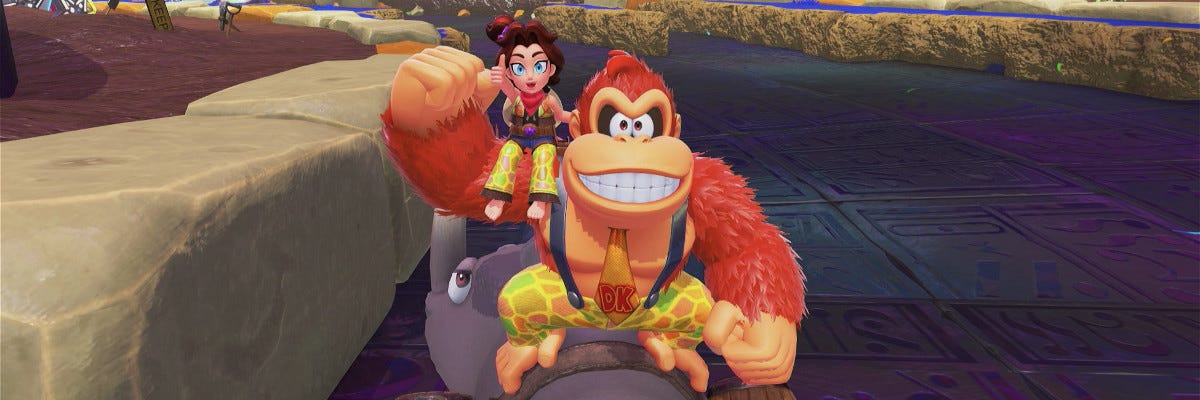
During this first act, we even see the contours of an actual plot emerge. The colony is attacked by an evil mining corporation called VoidCo, which buries the island underground. Donkey Kong then punches his way out from under the dirt and is joined in his adventure by an oddly shaped, sentient rock that soon after transforms into a young girl called Pauline. Together, they must journey to the Banandium Root contained within the planet’s core, as it is said to possess wish-granting powers. This way, Pauline can return to her home city on the surface, and Donkey Kong can obtain as many bananas as he wants.
Alright, so it’s not exactly War & Peace, but Bananza’s story foremost exists to give DK and Pauline a reason to keep moving forward—or well, downward. So far, so Mario. But critically, Bananza also departs from Miyamoto’s reductive views on storytelling in a 3D platformer.
For one, there is actual character development here. You can see Pauline gain confidence, and her friendship with Donkey Kong grows the more time they spend together. Donkey Kong himself has also been redesigned significantly, allowing for a greater range of cartoonish expressions that help his character come to life despite him having no dialogue.
Because yes, this game does have dialogue. Pauline has regular voice acting in English (or your language of choice), while most other characters speak with voiced gibberish—reminiscent of the babble in old Rare games—which Pauline can understand. It’s a bit of an unusual mix of dialogue flavors, but it does work rather well to convey that otherworldly magic of a human child exploring this hostile, strange land along with a big, benevolent beast. In this sense, the game almost feels like a children’s book or fairytale.
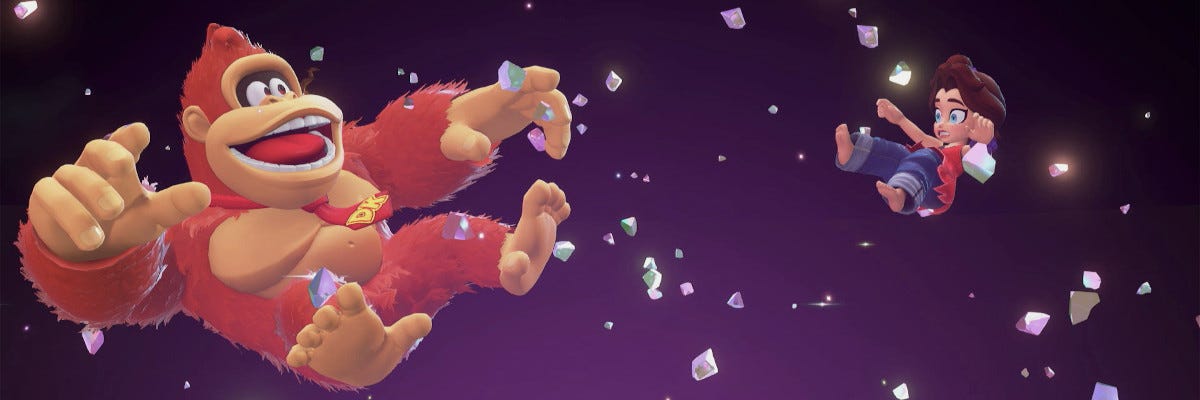
Being aware of this narrative premise is important because the why plays a significant part in how you traverse the world of Bananza.
Rather than moving through levels sequentially, the underground world of Bananza is divided into sublayers, with each layer (or level) representing a different world that may or may not conform to the conventions of platformer biomes.
For instance, the Resort Layer is your typical tropical paradise, whereas the Hilltop Layer features rolling plains and mythical stone structures. Things already become a bit more unusual with the Freezer Layer, which of course features a lot of snow and ice, but also sections with glowing lava. Later levels offer mixtures of themes, vibes and materials that increasingly defy standard categorization. This makes it all the more exciting to see what the next layer has in store.
Admittedly, it did take me a while to fully buy into the whole layer concept. I spent the first two hours of my adventure waiting for the game to move beyond its base premise. Going by comments from other players, this appears to be a rather common experience. One where you’ll spend twenty minutes punching through rock, after which doubts start to emerge:
Is that it? Is this the entire game?
These questions are difficult to answer. Of course, terrain destruction remains at the core of the gameplay. After all, this is Bananza’s entire deal. Yet what is done with that destruction and how it comes into play when navigating the game’s increasingly complex levels requires you to watch it evolve a bit before you can truly appreciate its brilliance.
I can’t even pinpoint the exact moment where the game started to click for me, as it wasn’t some fundamental change in my understanding of its design, nor a notable increase in challenge. Bananza merely kept adding new layers (I couldn’t avoid that pun forever, could I?) to this deceptively simple core mechanic until it became difficult to put my controller down.
For me, this process quickly turned Donkey Kong Bananza from a curious novelty into one of those gaming experiences I couldn’t stop thinking about. When I closed my eyes at night, I would see voxel-based rocks being smashed to pieces. When I played other games, I navigated levels with the tacit expectation to be able to climb up every surface and then tear it all apart.
This is also why I’ve avoided referring to the terrain-smashing gameplay as a gimmick, as this would be a disservice to how integral it is to the entire experience. It would be no more insulting to refer to Breath of the Wild’s open world exploration as a gimmick.
In digging through Bananza’s many layers, what stood out to me the most is how this game allows you to actually play the story without forcing you to unearth a significant amount of collectibles first.
Yes, at its core this is still a collectathon, with there being hundreds of golden bananas you can find throughout the game. But while they’re distributed every bit as liberally as Odyssey’s Power Moons, yet differ a lot in concept.
In Super Mario Odyssey, Power Moons are effectively the keys to the next level. You collect them as you explore each world, and once you’ve done enough exploring, you’re allowed to continue.
Not so in Bananza, where the degree to which you collect Golden Bananas is entirely optional: it is in fact possible to reach the final boss without picking up a single one.
Progress through the game is dictated entirely by your completion of story-critical activities, which mostly entail travelling closer to the planet’s core while you beat the bosses that the VoidCo corporation throws at you.
Golden Bananas will still come in handy, since you can use them to buy upgrades that allow you to gain more health, more strength and improve certain skills. While it’s again possible to ignore all of this, the game is balanced around the expectation that you have invested at least some points into making DK stronger.
This structure helps make Donkey Kong Bananza one of the best-paced collectathon platformers that I’ve played. For one, story objectives give context to what I am doing at any given moment. Even when I was knee-deep in being side-tracked by my hunt for bananas, I knew that my ultimate goal was to venture deeper into the planet.
It helped me avoid what I’d describe as sandbox fatigue—a sense of being overwhelmed that I tend to experience in collectathon platformers as I progress. When I’ve just spent two hours exploring a large, open level, the idea of then being dropped into a new, even bigger world where I have to start the process anew can feel like a chore.
An example of where I went through this emotion would be Yooka-Replaylee, a game that sits far closer to Donkey Kong 64’s bloated structure than does Bananza. Even though I enjoyed that game as a whole, I felt that each new level required me to invest emotionally from scratch. Still, I had no choice but to engage with these new stages as the game’s designated collectables (called Pagies) still retained their traditional function as the gatekeepers of progress. After a while, I was simply counting down how many of them were left until I could move on to the next world.
In Bananza, the moment where I move on to the next layer is one of my own choosing. Whenever I’d seen enough of a stage, I would just complete its story objectives and go yet deeper into the planet.
You might think such freedom comes with the risk that many players will want to rush through levels to get to the end, but I personally never felt this urge. Bananza’s worlds are finely crafted and invite discovery enough to render mute any rumination on their intimidating scope.
Critically, after each expansive, perhaps even overwhelming level, I would always be treated to a much smaller stage that I would maybe spend 10 to 15 minutes in. Whether they learned through testing or from experience, the developers seemed to know the exact moments where I or any other player would crave a smaller bite before we’d again be prepared to sink our teeth into something more substantial.
Oh, Bananza!
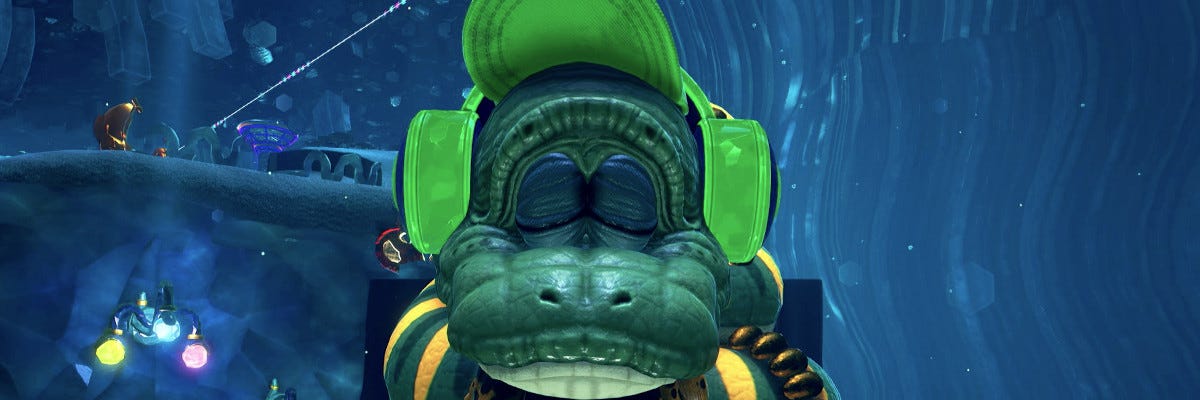
One way in which this game adds depth to its individual stages and the experience as a whole is the set of eponymous Bananza transformations that you unlock throughout the campaign.
These days, no self-respecting 3D platformer dares arrive to the scene without gameplay-altering transformations. Kirby has long had the copy abilities, and Super Mario Odyssey expanded upon its traditional power-ups with the context-dependent yet more permanent Cappy abilities.
Donkey Kong Bananza lands somewhere in the middle, offering a handful of transformations based on different animals that give you powers related to said beasts. The gorilla transformation makes Donkey Kong even stronger, the ostrich allows him to fly for short stints, and the zebra gives DK more speed while also making him able to cross brittle terrain. These powers can be activated at almost any time, provided you have harvested enough ‘Bananergy’ from the gold that you gain.
These ‘Bananzas’ last for about 30 seconds at a time, which is enough to give a new twist to Donkey Kong’s moveset and change how he navigates levels without becoming crutches that you’ll be tempted to activate on cooldown.
What I love about these transformations is that they don’t just serve whatever purpose a particular level extracts from them, as is often the case with similar such features in Odyssey and Astro Bot.
In Bananza, you don’t just learn a power, use it in a designated spot to make progress, and then put the toy back in the box. Once you unlock an ability, it’s yours for the rest of the game, and you can sometimes even use it to pull off small sequence breaks or puzzle skips in levels that weren’t designed around this specific transformation.
I’ve seen this ‘game-breaking’ potential levied as a complaint against Bananza, but I personally love it when games offer you an array of tools that you can then start exploiting in increasingly creative ways. If anything, such potential befits a game designed around exploration, destructibility and boundless freedom.
Bananza transformations are still far from Tears of the Kingdom’s crafting when it comes to their cheesing power, but they strike that same balance of allowing you to do things that were probably envisioned by the developers yet feel badass and borderline illegal when you pull them off.
The new age of Donkey Kong
A thought I haven’t been able to shake since finishing Donkey Kong Bananza’s main story is that the game feels like Nintendo temporarily freed itself from the burden of having to develop yet another genre-defining Mario game.
There are those who claim that Bananza should’ve been a 3D Mario game instead, as that would’ve presumably helped sell the Switch 2 even more in its first year on the market.
Beyond even the central gameplay mechanic being a much better fit for DK than Mario, Bananza does feel like a Donkey Kong game through and through. While we can discuss whether it qualifies as a reboot, the game does have some of the characteristics of one.
Whether it’s through characters, items, textures or even specially themed bonus levels, all of Donkey Kong’s history is acknowledged in Bananza, from his ancient arcade beginnings to his more recent exploits. Even the entries created by Rare are referenced here liberally, which came to me as a bit of a surprise. With Bananza being a new slate for the franchise that even includes a thorough redesign of the main character himself, Nintendo could have easily used the occasion to sever the series’ once intimate connection with Rare, a studio that now belongs to Microsoft.
But they didn’t, and it truly helps make Donkey Kong Bananza feel like the beginning of something new. A game that carries with it all of the franchise’s glorious legacy and recontextualizes it into a fresh, future-proof adventure. This approach makes the game feel grand, and without treading into the waters of spoilers, I will just say that this baggage helps an already fantastic finale emerge as one of the very few moments in a platformer that actually made me feel somewhat emotional once the credits rolled.
So to put it in modest terms, saying that Donkey Kong Bananza should’ve been a new 3D Mario installment criminally undersells what this game achieves.
This also applies to the gameplay, which feels more experimental and even risky than anything we’ve seen in recent Mario games. Said approach does come with a price, as it lacks that pristine polish that Mario always has. Bananza is still polished, mind, but there are moments where the camera, movements or even the framerate can show small signs of jank when you dig deep enough.
It comes with the destructible territory, and it is less of an issue because this is not a game about an Italian plumber tasked with both saving the princess and pushing the entire genre forward another generation.
Donkey Kong Bananza is free of that responsibility, and that freedom came to be expressed through the game itself. As such, the question of whether or not this game is better than Odyssey isn’t the correct one. Odyssey was a monumental effort, and a virtually flawless one at that. Together with Breath of the Wild, it heralded a new age for Nintendo.
Donkey Kong Bananza, meanwhile, is the foremost representative of the Switch 2 platform. The game shows that more processing power is not just useful for chasing higher fidelity—it can also be employed to create a richer, more chaotic gameplay experience with so many moving parts that it makes your head spin. With other Nintendo-published Switch 2 games such as Kirby Air Riders and the recent Splatoon Raiders also following this philosophy3, it gives us a good indication of what we can expect from the console in years to come.
Conclusion
I’ve always hated the term ‘killer app,’ both for its tech guru stench and its presumptuous nature. Ultimately, the release that makes you want to buy a console is much more of a personal choice than video game outlets make it out to be.
That said, I am confident in stating that anyone clamoring for a new 3D Mario game before they upgrade to Switch 2 will already find enough reason to do so in Donkey Kong Bananza.
As is much uncharacteristic in the modern industry, where new games are increasingly front-loaded in order to demand your attention from the very first moment, you may have to soldier through the first one or two hours before you buy into Donkey Kong’s latest adventure.
While I too went through this struggle, I came out the other end seeing Bananza as a wonderful, creative platformer crafted by experts who have decades worth of experience in the genre.
When even their primary rivals thank them for their achievements, it would be a mistake to pass up on their new masterpiece, even if it doesn’t bear Mario’s name.
Notes:
All screenshots taken and edited by me.
The Astro Bot GOTY 2024 acceptance speech referenced at the start and end of this article can be found here.
Wikipedia was consulted to confirm the release dates of the games mentioned, as well as to gain some background information on Bananza’s early development stages.
Read this article if you want to get a better sense of what collectathons are and why they fell out of favor.
I should stress that this only applies to mainline Mario platformers. Spin-off series such as Paper Mario often have a lot of charm and character.
You can even add the recent Switch 2 upgrade of Mario Kart 8 Deluxe to this list, since they added 8-player splitscreen just because they can.
Everything you've said I couldn't have put better. I'm currently playing through this and absolutely loving it, both on my own save file plus a separate one with my daughter so we can play co-op together - she chooses to be Pauline while I suppose I'm the lumbering ape!
It just feels so moreish. It's a collectathon where the collectables don't really matter. Yet it feels immensely satisfying punching everything and suddenly gold just spurts out of the terrain, making me want to smash more. I also love the character designs and style. DK's redesign seemed a bit strange when I first saw it, but now it seems so obvious because he is far more expressive and cartoon-like, and can show genuine affection for Pauline. The goofy transformations really make me chuckle too, I enjoy a game that doesn't take itself too seriously.
Perhaps one downside is the aforementioned co-op because the controls on the shared JoyCons are a bit awkward - not enough buttons and fingers contorting in strange ways to pull off every action. Even so, it's a great shared experience with a younger, less confident child.
It makes me happy to find someone else who sees this game for what it is, not what it should have been.
Great piece about DK Bananza :D. Loved this game at launch, loved making a video about it, and I love reading what others think about it. It's just so good? I struggle to call it "flawless" because it has many, but when DK hits it really hits hard.
edit: also would be interesting to hear your thoughts on the more arcade-y DLC if you pick that up for the post game. Lots of great RareWare fanservice there + a decent little side mode.