
Empathy-Driven Video Game Design
How developers can motivate players to actually care

Video games as a medium were originally light on story. The action on screen would seldom be justified by more than a basic premise. Even if a game did have more robust narrative elements, they would often be relegated to the accompanying game manual booklet in order to save precious space on the cartridge.
While video games didn’t always tell riveting stories in the early days, they did need that premise to give context to what the player was doing. Whether it was rescuing a princess or stopping an alien invasion, we needed a goal to work towards, something to care about, if we were going to commit our precious time to beating a game.
Of course, we’ve come a long way since then, and we now have many games that tell deep, emotionally mature stories that cast a light on the human condition.
Still, that basic requirement of driving player motivation has not changed. A game needs to set up the events of the game in a way that retains player interest early on. Then, it needs to find a way to keep them invested.
A common way to motivate players is to reward them in a literal sense. Maybe they get a strong weapon after completing a set objective. Or they level up and see their character become more powerful. Some games even reward players with an extra cutscene or alternate ending after they complete the game in a specific way.
While these are all valid design choices, there is a deeper way of encouraging players to remain invested: by making them actually care about the game world, its characters and/or the outcome that results from the player’s own actions.
Though this may sound straightforward, it’s rather difficult to pull off. It requires developers to have a deep understanding of the ‘universe’ they’ve created and how this world and its characters may tap into the emotions of their audience.
Tricky though it may be, it can be valuable, not just for the players but for the developers themselves.
Just think about it: if you are only doing a piece of content for the reward at the end - be it a costume, an OP weapon, or a fancy title - the content itself does not necessarily have to be good.
Players might simply choose to endure said content because they want the shiny object at the finish line. When they are then successful, instead of looking back and thinking “Wow, that was fun,” they might instead go “I’m sure glad that was over.”
There is something to be said for overcoming a difficult or even frustrating piece of content being its own reward. That is certainly true for FromSoft titles like Dark Souls and Elden Ring, where improvement through failure is part of the core gameplay loop. But naturally, this does not work for every game.
Some games take a radically different approach. By making you care about its world and characters, those games can reward the player by making their actions improve that world.

A good, if imperfect example can be observed in the first Life is Strange title. In this story-driven mystery game, one of the students, Kate Marsh, gets driven to a suicide attempt, finding herself on the roof of the school after she becomes a victim of revenge porn and the vicious bullying that followed.
You play as senior student Max Caulfield, and Kate is one of your classmates. During the climactic scene, you can attempt to talk Kate out of her plan to end it all. You can achieve this by reminding her of the things she loves, her values and the people who love her.
This is where things get interesting.
Because how can you tell Kate that her sisters would not want her to go through with this if you are not aware of whether she has any siblings? How can you convince her that you care about her when you’ve been ignoring her calls?
As it turns out, your actions leading up to this moment are as important as the words you choose during the exchange itself.
If you’ve been talking to Kate throughout the first portion of the game and have shown a genuine interest in her life’s story, her values and her doubts, successfully getting Kate to abandon her tragic plan is a lot easier to achieve.
In other words, you are rewarded for actually caring about the character. And the ‘reward’ is not a fancy outfit or what have you, but the character’s very survival.
It’s a clear instance of what I’d like to call empathy-driven game design.
Not that this example is perfect. The whole exchange still feels a touch ‘gamified’, with Kate almost robotically answering ‘that makes me feel good’ whenever you pick the correct response.* Nevertheless, it’s an example of how to emotionally satisfy the player for engaging with the game world.
Once more, I stress that this is extremely difficult to pull off. The Life is Strange franchise showed how fine the margins are with True Colors.
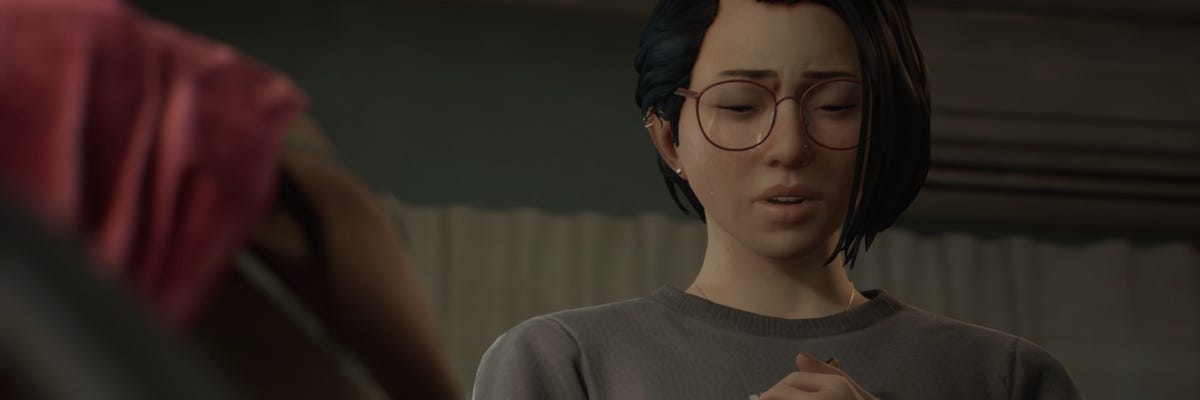
This fourth installment in the series, produced by a different studio, sought to turn empathy into a gameplay mechanic. Protagonist Alex Chen is portrayed as being extremely sensitive to the emotions of those around her, and even able to physically absorb these feelings.
An interesting premise, especially when you start to think of it as an allegory rather than a face-value superpower, but it ultimately fell flat because this desire to care was now just another gameplay mechanic for the player to interact with, rather than something that emerged organically from their inherent interest in the characters.
Fortunately, empathy-driven game design is not exclusive to these narrative-heavy games that try to tap into the player’s sensitivity through a gripping story.
Perhaps the best example of this type of design can actually be encountered in a game that is rather light on storytelling: Kirby and the Forgotten Land.
At a surface level, this 3D platformer follows many of the genre’s conventions. You travel from level to level obtaining collectibles in order to unlock new parts of the map.
This closely mirrors classic ‘collectathon’ platformers such as Super Mario 64, where you collected stars to unlock new levels and boss levels. Or Banjo-Kazooie, where these stars were replaced by jigsaw pieces, called ‘Jiggies.’
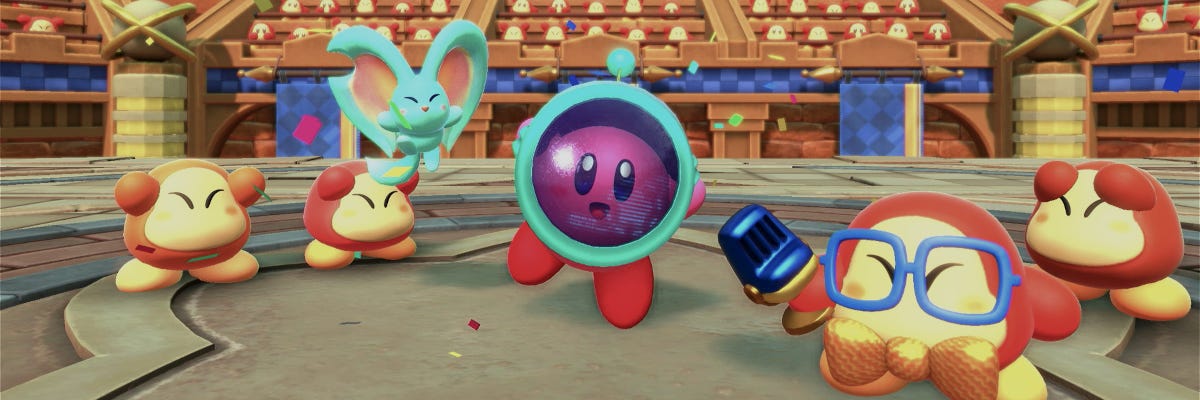
Kirby and the Forgotten Land provides a small, but brilliant twist on this formula. Instead of collecting stars, Jiggies or other such trinkets, you save Waddle Dees, cute creatures from the Kirby universe who became trapped in the ‘forgotten land’ that you explore throughout the entire game.
Waddle Dees can be encountered in various predicaments, but they are most commonly seen and/or heard while trapped in cages. They look like they’re in distress trying to get out, calling out for you (Kirby) to come and free them.
Once you free them, you are treated to a little animation where Kirby and the Waddle Dee(s) perform a little hug or dance animation. Once you complete the level, the Waddle Dees you’ve collected will then wave goodbye to Kirby, travelling back to their home town.
This Waddle Dee town actually serves as the main hub, where Kirby can recharge and play minigames. The more Waddle Dees you save, the more alive the town becomes. Not only do various services open - such as a restaurant, a colosseum and a fishing pond - but you can also just see Waddle Dees going about their day, relaxing in the sun, having a meal or reading a book.
Since this game is centered around gathering collectibles for progress, the choice of such an emotionally legible ‘collectible’ adds another layer to the gameplay.
You see, it is not necessary to collect all Waddle Dees to complete the main game. Yet I found myself just putting in that extra bit of effort every time I heard or saw a Waddle Dee in trouble. Effort I might not have put in if these cute creatures had been replaced by stars or other inanimate objects.
Crucially, the emotional gratification you might gain from saving the Waddle Dees is then expressed through gameplay, with the hub town becoming more alive as you progress through your quest.
The more you care about this world, the more it gives back to you. That is what empathy-driven design is truly about.
In encouraging me to engage with Kirby’s various side-objectives, I saw much more of what the game had to offer, increasing its longevity while also amplifying my appreciation of the whole experience.
It is one of the reasons why Kirby and the Forgotten Land clicked with me during a time where I had started to suspect that I had grown out of enjoying platformers. Turns out, I just needed a different kind of motivation, and I found it in the form of a rotund, pink hero who heals the world around him.
Now, should every game attempt to motivate their players through carefully orchestrated emotional investment?
No, of course not.
There are more ways of keeping players hooked - clever reward systems, a natural sense of progression, an engaging gameplay loop...
Besides, not every player will be as susceptible to this type of incentivization. If you just look at a character’s cries for help as an .mp3 file playing, then odds are you won’t be persuaded to go and help them unless there’s something in it for you. And that’s fine.
One thing that does hold true is that, as a developer, you should always think about how you intend to keep your players interested, engaged and satisfied.
And if you can create a world that invites the player to care on an intrinsic level, then empathy-driven design might be worth leaning into.
Now, if you’ll excuse me, I’m off to save some more Waddle Dees.
Notes:
*This analysis of the Kate Marsh rooftop scene is partially inspired by Whitelight’s great video on the entire game. Give it a watch here.