


As would’ve been the case for many of you, the first time I became aware of Astro Bot was when it got nominated for game of the year at The Game Awards 2024.
A Playstation-exclusive mascot platformer isn’t the type of release that will appeal to everyone, so by the time it emerged as a GOTY contender, the occasion was of course followed by a potentially lethal dose of tedious online discourse.
How could such a whimsical, family-friendly game even be worth considering for such an award over Mature Gritty Games For Cool Gamers Such As Myself™?
Such noises only got louder when Astro Bot actually won the coveted prize over nominees such as Balatro and Black Myth: Wukong. But while some indignation over that decision lingers to this day, part of the gaming community has also warmed up to the idea that Astro Bot served a bit of cosmic justice to both Sony and the industry at large.
Here we had this straightforward, joyous single-player exclusive that went against the grain and became a massive critical and commercial success. Fittingly, it released a mere two weeks after Sony’s other prestige project of 2024, the trend-chasing live service shooter Concord, which turned out to be a disaster of record-breaking proportions.
Now, I doubt I’m alone in taking any game-related award ceremony with a few teaspoons of salt. By itself, the entire notion of trying to cast an authoritative verdict on whether, say, a racing game is an overall better product than the latest FromSoftware release is a bit silly. That said, these ceremonies can give us a decent idea of the overall state of the industry.
If a 3D platformer can win such a prestigious award, maybe there is still a place for the genre in the modern gaming space.
As it happens, platformers—and especially 3D-flavored ones—have occupied a healthy chunk of my game time this year. Over the past months, I’ve been catching up on what the genre has had to offer in the HD era. In addition, I’ve also (re)visited many retro titles to help me develop a solid understanding of 3D platformers’ design trajectory over the years. It’s an ongoing journey that has thus far helped me discover some excellent releases, some of which I’ve written about in this very space.
Yet how confident can I really be in my newfound enthusiasm for recent favorites such as Kirby and the Forgotten Land and Donkey Kong Bananza when I haven’t yet played what might be the genre’s most lauded representative since Super Mario Odyssey?
Astro Bot had been near the top of my ‘to play’ list for months, as it felt like the missing puzzle piece in my rediscovery of what was once my favorite genre. There was, however, the minor inconvenience of it being exclusive to an expensive console that I did not own—one that even got a significant price hike during this time.
So after careful deliberation with my own conscience, I set my teeth into the most expensive bullet I’ve bitten in a while, and over the past week I’ve been playing Astro Bot on my very own Playstation 5.
Rest assured, there were plenty of other considerations that went into my admittedly decadent purchase, but for the joined purpose of brevity and the comedic timing ahead of GTA VI, I choose to stick to the self-deprecating narrative that I bought this console to play a single-player mascot platformer in 2026.
While I can already spoil that I enjoyed my playthrough of Astro Bot, I thought it interesting to review the game from the perspective I gained having spent so much time with the genre as a whole. Perhaps it’s this light obsession that has helped me spot a few things that I didn’t see reflected in mainstream coverage of the game. One such observation being which rival platformer Astro Bot is the most comparable to—and no, it’s not a Mario game.
So join me on this intergalactic journey through the world of Astro Bot. Not to worry, I’ve already paid for our entry fee.
Playstation celebration
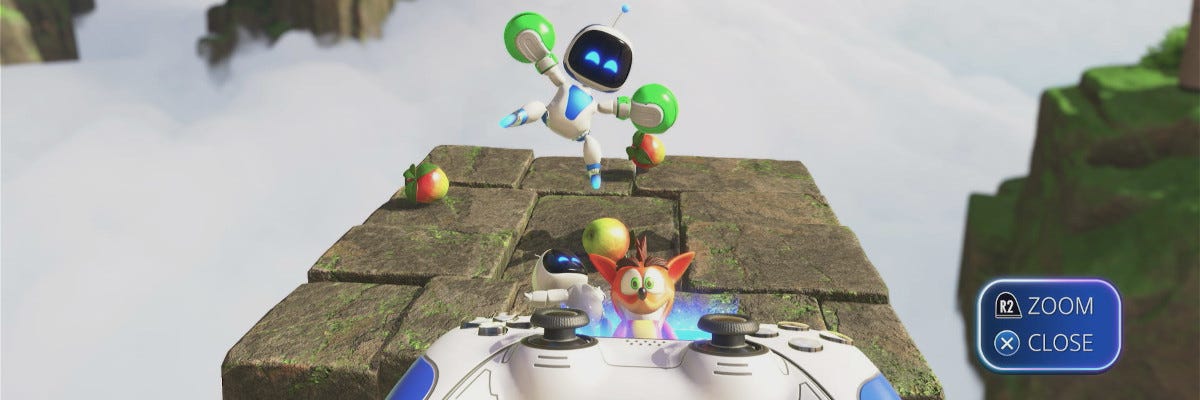
One of the most eye-catching features of Astro Bot is the premise that underpins the whole experience. Intended as a celebration of 30 years of Playstation, many core aspects of the game reference Sony’s hardware and properties.
No matter where you go, you are never far removed from unabashed Playstation worship.
In fact, it is impossible to even travel anywhere without participating in a tribute to Sony’s hardware, since protagonist Astro hops from level to level using a small space fighter modeled after the DualSense controller. This referential nature then stretches into the main objective of the game proper, which consists in helping Astro explore each world to look for his lost friends—stranded bots, many of whom ‘cosplay’ as characters from an array of different franchises that are in some way interwoven with Playstation’s history.
As you’d expect, these cameos include a lot of first-party characters like Nathan Drake and Kratos, but also guests from IPs that aren’t owned by Sony, yet have still played some part in their consoles’ history, such as Crash Bandicoot, Street Fighter’s Ryu and Ken, or even Gex the Gecko—one of the many platforming mascots whose careers stranded in the 1990s.
These bots are spread across different galaxies at the start of the game, when an alien attacks their mothership, which is of course a giant spacecraft shaped like a PS51.
Even as someone who has never been fully inside Sony’s ecosystem, the attention to detail stood out to me. The substantial franchise repping is impressive on its own, but the plethora of little objects, animations and other references to all things Sony really helps accomplish Astro Bot’s mission of becoming a playable museum of sorts.
We could of course make a boring argument here about nostalgia bait, but I hardly think it’s fair to levy that criticism against a game whose very purpose it is to revel in its own platform’s history. Besides, it would only have been an issue worth exploring if this self-congratulatory approach had gone at the cost of producing a worthwhile game.
Fortunately, this is far from the case.
Full spectrum warrior

It takes just a few levels to notice how the developers of Astro Bot—Sony’s in-house studio Team Asobi—did their homework.
Many familiar aspects from other platformers have inspired Astro Bot’s game design, with the developers cherrypicking a selection of different mechanics and techniques that together make for a highly satisfying platforming experience.
One of the more obvious such ‘borrowed’ ideas is the ability to briefly hover over gaps using Astro’s jetpack, an ability that is reminiscent of the hover mechanic that came with the FLUDD system in Super Mario Sunshine. Still, this resemblance does not mean that Astro Bot plays much like Sunshine or even Mario in general.
Astro’s controls are snappy and responsive, and unlike Mario they do not require you to play around a floaty sense of momentum in order to achieve the best results. Perhaps the closest analog here would be Crash Bandicoot, but only when it comes to the core platforming movement, as Astro Bot (fortunately) does not demand as much precision due to the main character’s more forgiving moveset and the less punishing level design.
It is in fact this very level design that makes it easy to forgive some of Astro Bot’s more derivative design choices, as it is consistently strong and creative throughout most of the game. Each stage is built around the idea of allowing the player to have fun with Astro’s moveset and the game’s other primary gameplay systems. Concretely, this amounts to playing around with verticality, liberal use of the hover ability, and screwing around with physics at any given opportunity.
These game worlds feel all the more alive when you discover that most objects within them will in some way react to Astro’s touch or presence. There’s a lot of stuff to break or throw around, but even more enjoyable are the smaller effects, such as using Astro’s weight to put a satisfying dent in a hot air balloon by standing on top of it.
Most interactions are further enhanced by the ample use of the DualSense controller’s secondary functionalities. During a storm, you can hear raindrops fall through its little speaker, and if you shake your controller, it feels as if the bots you’ve collected in the level are moving around in there. There are also some truly DS-esque interactions such as blowing into your controller to make a gust of wind appear in the game.
Since I was completely ignorant of the capabilities of the PS5’s proprietary controller beyond its standard rumble feature, all of this was a pleasant surprise to me. Astro Bot’s designers went the extra mile to showcase the gamepad’s multifunctionality—no doubt a result of the series’ tech demo origins—but for the most part applied much-needed restraint to prevent such gimmicks from dominating the overall experience. That said, I did not care for some of the motion controls (gyro aiming never felt natural to me), and Astro Bot’s reliance on the DualSense’s many features did drain the battery noticeably faster compared to other games on the system.
Still, employing the DualSense as a way of achieving a ‘full spectrum’ experience does feed into Astro Bot’s overarching design philosophy of constantly surprising the player.
The contours of this approach become all the more apparent when we take a look at the game’s power-ups. Like most modern 3D platformers at this point, Astro Bot relies on an array of transformations that amplify the player’s core moveset, which in turn allows the level designers to come up with more complex navigational puzzles that exploit these new moves.
As I was making my way through the first handful of levels, the highlight of each stage was discovering what new power I’d get to play with. Whether it was a balloon that Astro could propel himself into the air with, a dog-shaped rocket on his back, or a clock that allowed him to stop time at will, nearly every transformation added a meaningful twist to the way I’d experience the game while playing as Playstation’s budding new mascot.
I’ve deliberately avoided mentioning more than a few initial transformations, as the sense of surprise that you get from discovering these abilities is part of the core appeal of the gameplay loop.
Much like the Cappy abilities in Super Mario Odyssey, these enhancements prevent the player from settling on a rigid idea of what the main character can and cannot do. But unlike in Odyssey, entire levels were built around these transformations, instead of just a specific section or puzzle.
It has to be said, though, that the levels in Astro Bot are a lot more compact than in any of the recent sandbox platformers. Most of them can be completed in 10 to 15 minutes, and probably a lot faster if you don’t try to get all the bots and puzzle pieces. These collectibles are often hidden off the beaten path and require both light environmental puzzling and general observational skills to uncover. So while the levels are—with a few exceptions—linear, your otherwise straightforward path will be littered with little detours.
From the start, I actively tried to find all bots in every level, both because I was curious which cameos I’d uncover and because my total number of saved bots served as the gateway pass to boss fights and new sections of the game, much like collectibles in pretty much any other big platformer that isn’t Donkey Kong Bananza.
It’s this combination of linearity and exploration, as well as the level-specific power-ups, stellar presentation and the excellent incorporation of the DualSense hardware that makes Astro Bot’s opening hour among the strongest I’ve played in any platformer, or even in a video game in general.
But does this PS5-shaped UFO stick the landing?
Lost in space
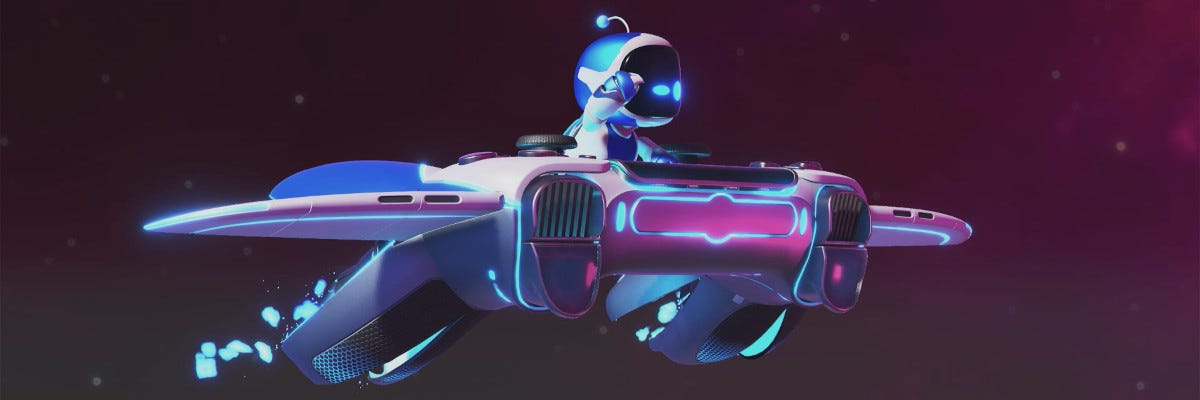
The more I progressed through Astro Bot, the more the limits of its design started to reveal themselves.
This starts with the levels proper, which are grouped into different worlds, or galaxies in sets of five main levels and a boss stage. As I started to explore more of these galaxies, I realized that I could not discern any meaningful thematic pattern in them.
The first level in a galaxy could be themed after a casino, whereas the next one took you to an East-Asian bathhouse, followed by a stormy tropical island.
While in itself, this sheer variation in aesthetics and assets is to be praised, the random nature also leads to a lack of cohesion. That’s not to say that Astro Bot should’ve just committed to the standard platform fare of having a grass galaxy, a desert galaxy, a water galaxy and so forth, but the lack of any and all context does hurt the experience the further you progress.
In his autopsy of the ill-fated Crash Bandicoot game Wrath of Cortex, J’s Reviews points out that one of the main reasons for that game feeling relatively directionless is the total absence of narrative topography. As the original Crash trilogy had demonstrated, even some basic logistical structure that explains why we are where we are goes a long way towards helping us connect to the game world.
While, as mentioned, Astro Bot also tends to be more random when it comes to its level line-up, it’s a lot harder to pick up on at first. I’ve been thinking for a while about why I only started noticing this relatively late in the game, and the best answer I can give here is that, initially, the constant changes in scenery play into Astro Bot’s theme park structure, where every level is its own, incredibly fun ride that doesn’t need to be part of a cohesive framework to succeed.
When I got deeper into the game, this effect eventually began to lose its hold on me, by which point I grew more conscious of the cumulative effect of being pulled into a new direction at every turn, as the levels themselves also began to run dry of surprises.
Just to be clear on this, all of what I’m describing here is the type of analytical nitpicking you’re condemned to engage in when you, like me, have played so many platformers that it drives you towards a level of scrutiny that makes such nuances stand out.
If you were to play Astro Bot after five years of not having bothered with a platformer, I doubt you would notice any of this—let alone be bothered by it.
Still, what did somewhat hurt my overall experience was the broader issue of Astro Bot not really building up to anything. Apart from the later levels being a bit more challenging and offering up more boss encounters, I didn’t feel like I was approaching the final level until I had actually reached it.
Again, this is not unheard of in platformers. These are games centered around the joy of navigating a virtual space and the obstacles they contain—they are not narrative-driven action-adventure epics culminating in an hour-long boss battle. And yet, when I reviewed Donkey Kong Bananza the other week, I could note how that game’s subtle but constant reminders of my final objective helped slowly build tension across the campaign, resulting in Bananza—a game that’s every bit as light-hearted and colorful as Astro Bot—achieving a satisfactory emotional pay-off upon its conclusion. This was further aided by Bananza saving some of its best levels for last.
By contrast, even though Astro Bot offers a finale that I can only describe as an outright spectacle, it could not entirely remedy my overall feeling that the game was starting to run a little (and only just a little) short on fuel in the final few regular levels. In addition to the aforementioned lack of build-up, I started encountering more levels that either didn’t give me any power-up at all, or recycled an already introduced upgrade without expanding on its previous appearance in a meaningful manner.
As established, the effectiveness of Astro Bot’s gameplay loop relies heavily on the game’s ability to surprise the player. While this works out perfectly during most of Astro’s adventure, for me, the slight but noticeable slump near the end made an otherwise sensational final punch not land in full.
Astro’s Playbook
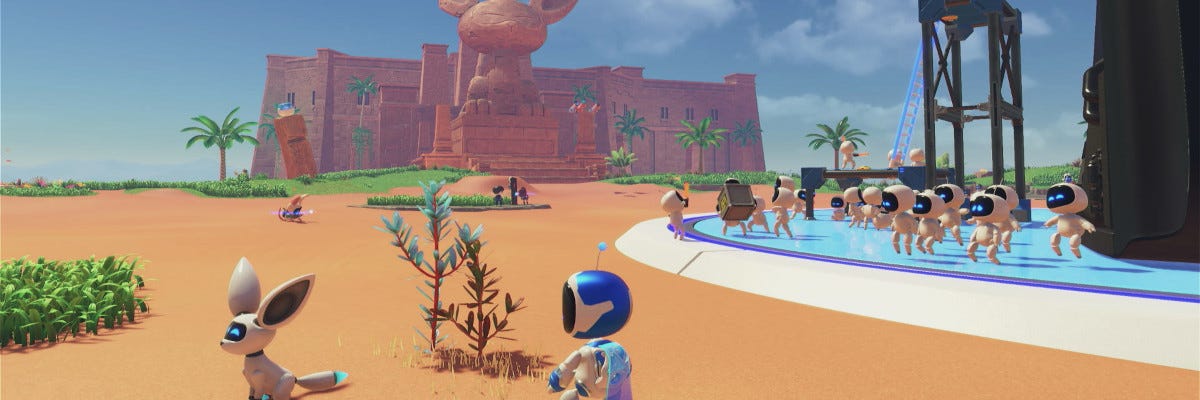
That we can at all engage in direct comparison between Astro Bot and some of the best platformers out there is already a huge testament to the overall quality of this game. In borrowing design elements from Super Mario Galaxy and Super Mario Sunshine, it is remarkable how well Team Asobi have done to incorporate these into Astro Bot’s DNA without the whole experience feeling like a cheap knock-off. In fact, I prefer how the hovering feels in Astro Bot compared to Sunshine, and I enjoyed my first playthrough of this game more than I did my respective replays of Super Mario Galaxy 1 and 2 earlier in 2026. That is something that, a year ago, I never thought I’d be able to say about another platformer.
Those who dismiss Astro Bot on the basis of its similarity to prior platformers should know that the genre has existed for so long that a degree of overlap with other properties is at this point almost inevitable if a developer wants to avoid reinventing the wheel. Besides, with its unique use of the DualSense controller in particular, Astro Bot does more than enough to feel distinct and fresh as a gaming experience.
However, it is still worth zooming in on some of the similarities between Astro Bot and prior releases in the genre, since its competitors would sometimes be faced with the same design questions, yet came up with different answers.
Though at a surface level, some of Astro Bot’s mechanics can be traced back to various Mario installments, it is in analyzing the game’s underlying structure that a different comparison comes to mind.
When we chart the game’s compact, linear-ish levels filled with small puzzles and hidden paths, from which we can save a total of 301 lost friends, who then go to inhabit a small hub world that gains more services as we progress, we have also described the exact design principle behind Kirby and the Forgotten Land.
That’s not to say that Astro Bot is a mere Kirbylike. Forgotten Land was originally released in 2022 after a reported development time of around four years2, which means work on the game would have started around the time that the PS4 Virtual Reality title Astro Bot Rescue Mission was released.
As its name suggests, Rescue Mission already featured the concept of saving lost friends through mostly linear platforming levels. Forgotten Land had a similar system, where throughout his adventure Kirby had to rescue Waddle Dees who’d then set up shop in a shared hub world that came to life more with each Waddle Dee that was rescued. In its turn, Astro Bot’s ‘evolution’ of this concept shows a lot of similarities with Forgotten Land.
Even though I cannot find any official statements from either Team Asobi or HAL Laboratory, I do think there may have been a creative back-and-forth here. My suspicions of a reciprocal inspiration loop were further fueled by many similar animations, mechanics and other small moments that appear to draw some direct parallels between these two otherwise unrelated IPs.
Even if this is a freak case of convergent evolution, and two different studios just happened to have stumbled upon a similar design framework after they were tasked with laying the foundation for modern 3D platforming experiences, it can be interesting to briefly look at how Kirby and the Forgotten Land handled its pacing. Because in this sense, Forgotten Land is almost the inverse of Astro Bot. Where Team Asobi’s effort is front-loaded with spectacle, Forgotten Land adheres to HAL Laboratory’s general philosophy for Kirby games: approachable, yet deep.
As has become staple in the Kirby franchise, Forgotten Land sets out with a series of rather normal platforming biomes, and then begins to subvert these expectations by inserting increasingly bizarre, unnerving elements into the later levels. These different zones are then harmonized through the overarching theme of a post-apocalyptic world, which helps instill aesthetic cohesion into this otherwise varied set of stages.
The result is a sense of place that contrasts Astro Bot’s randomness, yet never becomes so overbearing that it gets in the way of a fast-paced, creative platforming experience with plenty of variation.
Also worth inspecting is Kirby’s set of signature copy abilities, since they are Forgotten Land’s equivalent to Astro Bot’s level-based power-ups. Here, the difference is that these copy abilities can be selected at will by the player for pretty much any level, and they also come in different variants that are all individually upgradable. This system is surprisingly profound: despite already having spent over 50 hours with the game, just this week I discovered a completely new move for one of my favorite copy abilities after watching a random gameplay clip by another player.
While allowing us to choose freely between suit enhancements would not seem viable in Astro Bot since the respective levels in which they appear are so meticulously crafted around them, adding more flair through upgrades or slightly richer movesets could help prevent the game’s inevitable sequel from ever losing momentum.
As it stands, Astro Bot’s reliance on the element of surprise for revealing its new abilities and locales is both a strength and a weakness. The initial shock effect is great, but it does wear off when the toy has to be put back in the box at the end of the level, and we are dropped into the next area with a clean slate. Even when an ability or level aesthetic is brought back in a later level, it doesn’t always carry over that initial ‘wow’ effect.
A new Astro Bot game would be able to iron out these last few folds if it finds a way to diversify its power-ups without hurting the creativity of the level design, and if it can instill a modicum of thematic consistency to more effectively build tension across the campaign.
Thankfully, there are plenty of games that Team Asobi can draw inspiration from, and there is little doubt in my mind that an Astro Bot sequel would in turn inspire others to take their platformers to the next level.
All of this is to illustrate that this ‘cross-pollination’ between different franchises in the platforming space is a natural process resulting from different studios finding solutions to similar challenges. If anything, a healthy balance of inspiration and innovation is exactly what has helped Astro become such a fierce rival to some of the genre’s most experienced heroes.
He is Astro Bot (Conclusion)
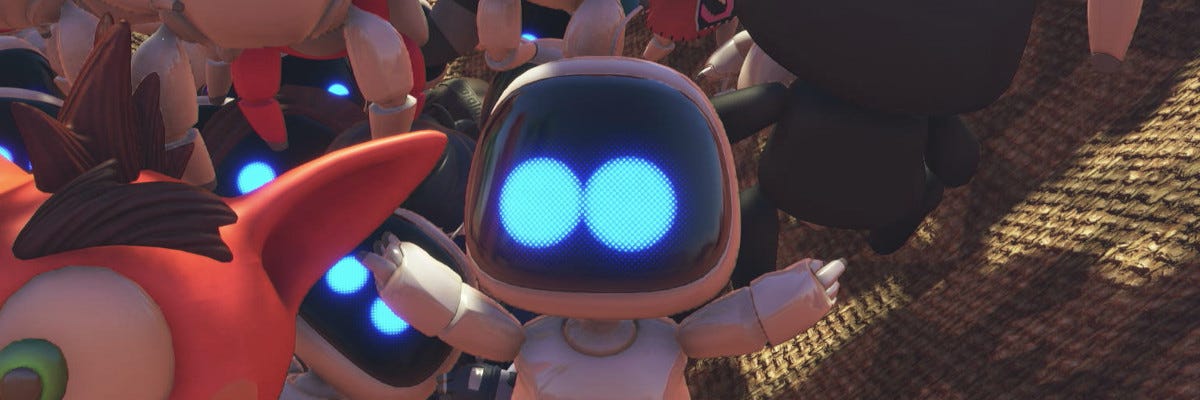
The accolades that Astro Bot received at the end of 2024 were not only deserved, but important.
To a company that got caught up in chasing the live service dragon and paid a hefty price for its failure both financially and reputationally, Astro Bot showed that a video game project does not need to conform to the medium’s latest fads to be successful.
To the wider industry, Astro Bot demonstrated the value of a video game crafted by people solely concerned with delivering a positive, rewarding gameplay experience, free of cynical ploys aimed at short-term profit optimization3.
And most importantly, to many regular players, Astro Bot was a strong reminder that video games are supposed to be fun, and that some gamers’ inability to enjoy new releases may not in fact be the fault of their own joyless cynicism, but rather of a profusion of uninspired, calculated products on the market.
Me, I was fortunate enough to have already found a few such reminders along the way, before I committed a frankly inexcusable amount of funds to joining Astro Bot’s Playstation-exclusive party. Still, I only felt intense happiness as I explored the first few levels of the game, as I realized I’d found yet another reason to conclude that things aren’t all bad in this hobby.
Companies big and small still regularly put out games that evoke a sense of childlike wonder in those who get to play them. It’s just a matter of drowning out the noise of a hyperactive industry that continues to put out more titles every year than anyone could physically play in a lifetime.
I hope that this current publication can help you navigate this torrential rain of new releases and aid you in uncovering the joyous gems that this medium still has to offer.
Despite some of the minor complaints I raised against Astro Bot’s broader design, Team Asobi’s effort made it into my personal top 5 of 3D platformers to date. If you paid attention while reading this article, you can probably take an educated guess as to which ones are still ahead of it in my book.
My personal preferences aside, it is admirable how Astro Bot’s first full-length adventure immediately puts it in the same conversation as the likes of Mario and Kirby.
It helped give Astro Bot’s celebration of 30 years of Playstation an ironic lining, since for how many iconic platforming heroes he encounters during his adventure, Astro is already well on his way to surpass all of them. It’s actually what makes the game’s nostalgia trip palatable—this little robot has earned the right to hang out with all these legends.
Should Team Asobi remain able to outdo themselves with their upcoming projects, there is no doubt in my mind that Astro Bot will continue to establish itself as Playstation’s prime platforming experience.
As I referenced in my previous article, Team Asobi’s director Nicolas Doucet thanked Nintendo during his acceptance speech at the 2024 Game Awards. A meaningful gesture as, to the Kyoto giant, Astro Bot may once have seemed an admirable disciple, but it has since come to establish itself as its most formidable foe.
And who knows, Mario might just pick up a few tricks from Astro’s playbook for his next adventure.
Notes:
All screenshots taken and edited by me.
Now that I own a PS5 myself, it indeed feels like I have an oversized UFO in my own home.
I see the figure of six years float around on the internet, but some representatives of HAL Laboratory have mentioned a slightly shorter time. Perhaps this variation comes from how much of the planning/experimentation phase is included.
On the off-chance the suits didn’t fully pick up on this, Larian Studios’ Swen Vincke, who got to announce Astro Bot’s victory to the world, spelled it out for them in his entertaining and prophetic speech beforehand.
Might I recommend a certain adventure of a lombax named Ratchet and his adventures with a robot called Clank wherein they travel across Rifts that are split Apart to you if PS5 "platformers" are of interest to you :D
I remember watching a presentation by Mark Cerny during COVID times where he wasn't showing the then upcoming PS5, but talking up the big features it was going to have. One of them was the DualSense controller, and how he envisioned how it would add to your gameplay experience.
Astro's Playroom and Astro Bot are the only games I think that do that controller justice. The game and design itself are excellent, but what really adds to it is the connection I (literally) feel through that controller. Walking over different surfaces give different tactile responses to my hands, pulling back springs with the triggers feels tougher the more I pull back, I can hear nearby sounds through the controller. I became incredibly immersed in the game, and not because of flashy graphics, because I could really feel it. That aspect alone means Astro Bot puts a lot of so called immersive, triple-A games to shame.
Overall I agree with everything you said. It's a game about fun and joy, and it's a shining light amid a sea of drab, grey "serious" games.